About the Conference
Where seventy-seven years of agricultural statistics meet eighty years of marine fisheries science — and the possibilities of artificial intelligence.
77th Annual Conference of ISAS
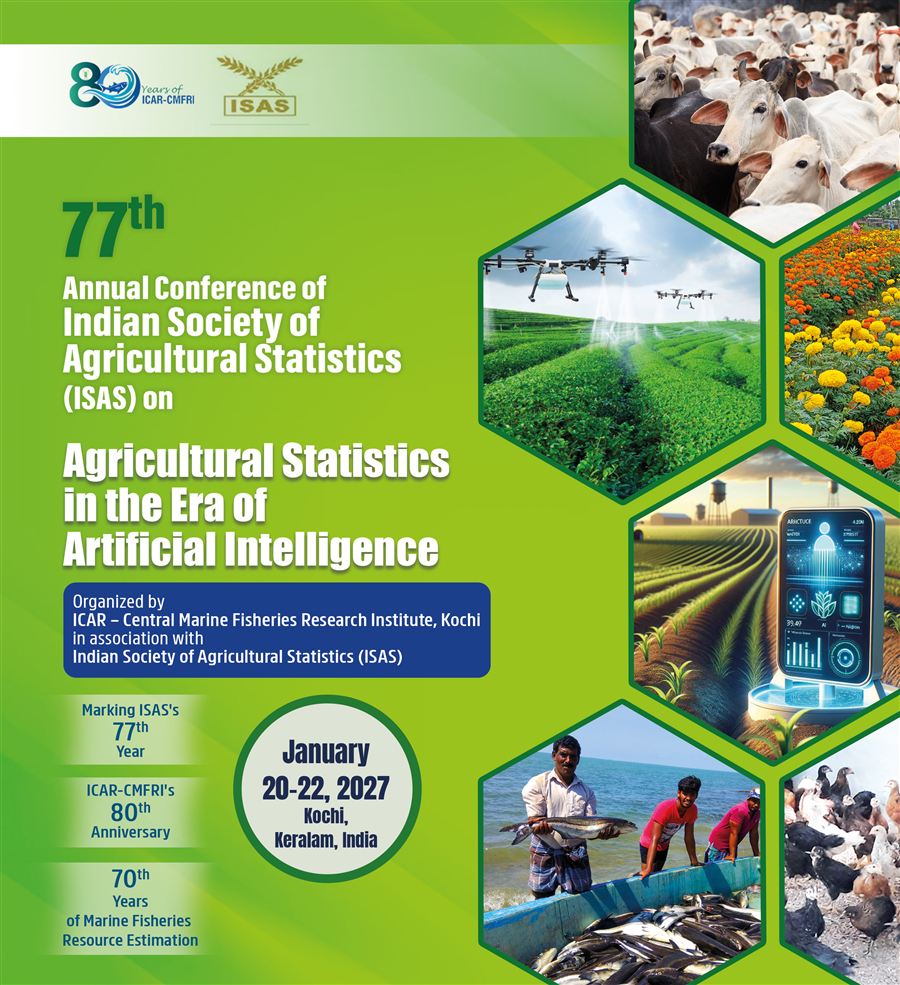
The Indian Society of Agricultural Statistics (ISAS), a premier professional body in the field of agricultural statistics and allied sciences, is organizing its 77th Annual Conference on Agricultural Statistics in the Era of Artificial Intelligence from 20–22 January 2027. The Conference will be hosted by the ICAR–Central Marine Fisheries Research Institute (ICAR–CMFRI), Kochi.
The 77th Conference falls at a unique three-way confluence of milestones: the 77th year of ISAS itself, the 80th anniversary of ICAR-CMFRI’s establishment, and the 70th year since CMFRI’s landmark stratified multistage random sampling methodology for estimating marine fish landings and effort was first formulated — a design that continues to anchor India’s national marine fisheries statistics today.
Purpose
This Conference seeks to explore how data-driven decision-making, increasingly powered by artificial intelligence, can transform agricultural and fisheries research, education, extension, and policy. Emphasis will be placed on integrating statistical science with society spanning crop and animal systems to marine fishery resource assessment ensuring that modern data technologies translate into practical solutions for farmers, fishers, communities, and policymakers.
Platform
The Conference aims to provide a platform for academicians, researchers, policymakers, and industry professionals to discuss contemporary challenges and innovations across agricultural statistics, marine fisheries science, and artificial intelligence. The insights generated are expected to promote scientifically sound, socially relevant practices, and to chart a course for sustainable, inclusive, and technology-enabled growth across India’s agricultural and marine fisheries sectors.
Indian Society of Agricultural Statistics
The Indian Society of Agricultural Statistics (ISAS), a premier professional body in the field of agricultural statistics and allied sciences, was founded on January 3, 1947, with Dr. Rajendra Prasad as its Founder President, who continued to guide the Society for 16 years even after becoming the President of the Republic of India.
The Society’s primary objective has been to disseminate research in Agricultural Statistics and informatics to address challenges in agriculture. It publishes the “Journal of the Indian Society of Agricultural Statistics” (ISSN 0019-6363), a unique platform for applied statistical research aimed at enhancing agricultural research and development across India.
Continuing its mission, ISAS, in collaboration with ICAR-Central Marine Fisheries Research Institute, Kochi, is organizing its 77th Annual Conference during January 20–22, 2027, providing a forum for statisticians and researchers to share insights and innovations.
Fisheries Science Division (SMD) of ICAR
ICAR’s fisheries research and education mandate is coordinated through its Fisheries Science Division at Krishi Bhawan / KAB, New Delhi, under a Deputy Director General (Fisheries Science). The major thrust foci pertaining to inland and marine fisheries research are guided by two Assistant Directors General.
This Division oversees a network of specialised national institutes covering marine, inland, brackish water, and cold-water fisheries research, aquaculture, post-harvest technology, genetic resources, and fisheries education of which ICAR-CMFRI is the apex institute for marine fishery resources.
Marine
Inland & Cold-water
Brackish water & Aquaculture
Genetic Resources & Education
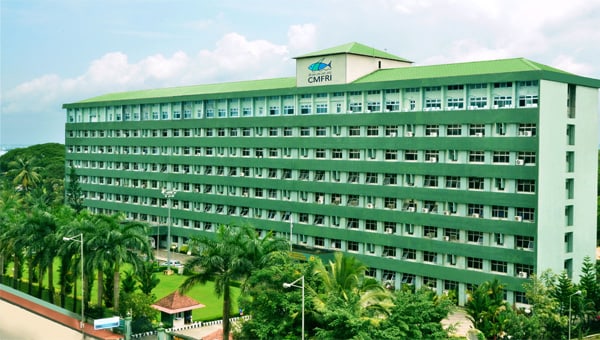
ICAR-CMFRI — 80 Years of Marine Fisheries Research
The ICAR–Central Marine Fisheries Research Institute (ICAR–CMFRI), Kochi, established in 1947, will commemorate 80 years of dedicated service to marine fisheries research and development in 2027. Over eight decades, CMFRI has built India’s national marine fisheries data system, advanced stock assessment science for the country’s marine resources, and supported policy formulation for sustainable marine fisheries management through its headquarters at Kochi and a network of regional and field centres along the Indian coastline.
The 80th anniversary provides an opportunity to highlight the evolution of marine fisheries research, data systems, statistical methods and scientific support to fisheries management, and to connect these institutional milestones with emerging opportunities offered by artificial intelligence and advanced data science.
Fishery Resources Assessment, Economics and Extension Division
The year 2027 marks 70 years since the stratified multistage random sampling design, developed by FRAEED (erstwhile FRAD), was first crystallized for the estimation of marine fish landings and fishing effort. This design has anchored India’s national marine fisheries statistics ever since, making it one of the country’s longest-running, continuously operated scientific data programmes.
Current Thrust Areas
Composite estimation of marine production
Integrating multiple data streams into unified production estimates.
AI-driven identification & quantification
Applying machine learning to species identification and stock quantification.
Signal-based detection of fishing grounds
Using vessel and acoustic / remote-sensing signals to identify active fishing grounds.
Grid-based catch & abundance indices
Spatially resolved catch and abundance indices at a grid-cell level.
Oligo-stock simultaneous stock health model
A multi-stock framework for ecosystem-based health of marine fishery resources across the Indian EEZ.
Motivation and Objectives
Marine fisheries and agriculture together form a vital part of India’s socio-economic structure, supporting the livelihoods of millions of fishers and farmers. Both sectors face challenges from climate variability, resource variability, market volatility, and limited access to scientific knowledge. Agricultural and fisheries statistics strengthened by artificial intelligence can bridge these gaps by enabling evidence-based decisions, strengthening extension and outreach, and guiding innovation from the grassroots to the policy level.
With growing emphasis on data-driven solutions, this Conference will foster dialogue on statistical methodologies, AI-driven analytics, climate-smart agriculture, and the integration of digital technologies across farming and marine fisheries systems, in line with India’s vision of sustainable resource management and food security.
The inclusion of fishers, fisher-based organisations (FFPOs), farmers, students, and researchers from CMFRI and allied ICAR institutes ensures that the knowledge generated during the Conference translates into real-world benefits empowering fishing and farming communities, building capacity among young researchers, and strengthening the effectiveness of extension and outreach systems.
Objectives
- To deliberate on the integration of agricultural and fisheries statistics, digital technologies (AI, remote sensing, IoT) and sustainable practices.
- To create a platform for students to learn, present research papers and poster presentations and engage with experts in agricultural and fisheries statistics.
- To strengthen the role of FRAEED, CMFRI, and the wider extension network as knowledge disseminators and connectors between research and practice.
- To provide fishers, FFPOs and farmers with exposure to innovative practices, AI- and data-driven solutions and success stories.
- Panel discussions on policy, innovation, and global challenges in agriculture and marine fisheries management.
- To foster collaboration for knowledge exchange and policy alignment across ICAR institutes, ISAS and international bodies.
- Special workshops on advanced statistical tools and applications for agricultural and fisheries data.